Choosing Straw Bales for Home Construction
Bale type, which size is best, how to handle moisture content, and what are the ideal straw bales for home construction; are all common questions we hear at every workshop. BECAUSE getting the right bales is really important! This choice affects the amount of labor needed for installation, the integrity of the wall system, plaster details, quantity of plaster required, and more.
And, sourcing the right bales EARLY in your straw bale home construction process provides key benefits:
Known dimensions for the straw bale home design stage - Designing for the bale size can reduce notching and custom bale shaping during construction, thus reducing labor.
Peace of mind - Knowing your bales are stored in a dry location of your choosing and accessible when you need them.
Plenty of time to locate quality, LONG-STRAW, for-construction bales - Ease of installation and they better maintain their shape, even with through shaping and retying.
We Love Long-Straw
“Long-straw bales” are bales made of straw, or the dried stalks of grain crops, that are typically 14” tall (in 2-string bales) and 16” tall (in 3-string bales.) ‘Short-straw bales’ contain straw lengths usually closer to 6 inches long. (Note: Both types of bales can have similar bale dimensions, it is just the stalk length of the straw that differs.)
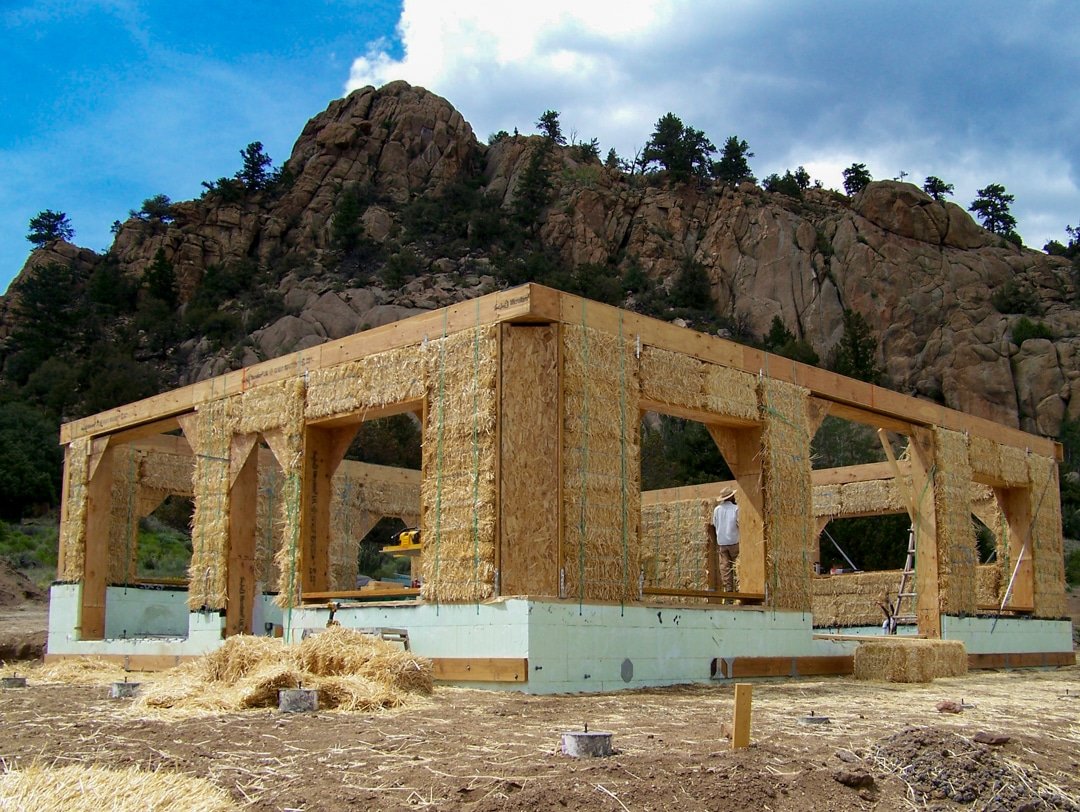
Long-straw, for-construction bales in use on a bale home using the hybrid wall system; a combination of post-&-beam and load-bearing.
Different types of harvest machinery will produce the different bales types, for example, a rotary combine will chop and twist the stalks before creating a bale, which produces a short-straw bale.
Short-straw bales also occur when harvested from a shorter stalk crop. These crops seem to be more common as agricultural preferences lean towards grain yields with shorter stalks.¹
Short straw generally makes for a weaker bale and is a less-than-optimal choice for construction. These bales tend to fall apart more easily and are more challenging to shape when notching around framing; they feel soft and require more retying to firm up. Using short straw to stuff holes and shape curves is also more difficult. The short length just doesn't hold in place as well as the longer stalk lengths, even the tried-and-true technique of twisting a handful of straw to bind it does not work as well.
Instead, the greater length of stalks in a ‘long-straw bale’ helps to maintain the bale integrity as you manipulate the bales when retying, cutting, or shaping. These bales are usually produced by a conventional combine, which removes the grain heads and then processes the stalks into bales WITHOUT the chop and twist action, or by a traditional, smaller tractor using a sickle mower that cuts the stalk low to the ground.


Sourcing Straw Bales for Home Construction
When sourcing your bales, ask the producer if the bales are construction quality and if they are ‘long straw.’ It is also important to ask about moisture content, delivery details & costs, how the bales were stored, and any timing needs for your build schedule.
If you do end up with bales that have short straw, the use of 2"x 2" welded wire mesh will help contain the straw as you detail your wall, windows, doors, and custom niches.
During the bale setting portion of the build, it is useful to have the means to contain and remove the loose straw produced during the reshaping and notching of bales. It can then be collected for repurposing (gardens, livestock bedding, etc.) and reducing job site hazards, such as fire, slips, trips, and falls. Not to mention how tools can quickly disappear in those straw piles!

Loose straw produced during reshaping of bales is safely captured for reuse by Carol Palmer, master gardener and environmental educator on Navajo Nation. 2022 AZ Straw Bale Workshop.
You can undoubtedly use short-straw bales, but long-straw is ideal and worth the extra research time to source. It will save you time and help avoid the struggle bus as you raise your bale walls! (Can’t locate long-straw bales within your area? Look for high-density, well-compacted short-straw bales.)
More Considerations For Your Bale Choice

1 >>> Moisture Content - You want to make sure the moisture content is between 8%-13% as measured throughout the bale with a moisture meter, or bale probe. (Lower is, of course, better!) As a general guide, we don’t recommend using bales above 18%. Once a bale is above 20%, there is adequate moisture to support mold growth. Give a good sniff test as well to check for a musty smell. You’re looking for a fresh straw scent.
2 >>> Density & Quality - Compressed, tightly strung, dense for-construction bales are highly desirable. They should easily pass the ‘one-string’ test, meaning when you lift a bale by one string and it does not deform or explode into a pile of loose straw!
3 >>> Cleanliness & Color - Avoid bales with dirt packed into them or a brown/black color to them; this color indicates moisture-damaged areas. Instead, look for the bright gold color of a freshly harvested crop.
4 >>> Size & Shape - Straw bales used for construction are typically classified as two or three-string bales. 2-string bales are smaller (14"-16” x 18” x 36") and use only two strings to bind them together. 3-string bales are larger in size (15"-16” x 24” x 46"- 48”), heavier, and have three strings holding them together.
Farming equipment used in your area may determine which size bales are most readily available. Verify the bale size you will be using before proceeding with your home’s design, as designing for the size of bales in coordination with framing, window/door placement, etc can reduce labor during construction. Taking this early step to know local sizing will reduce a huge headache when it’s time to purchase your straw bales.
5 >>> Grain Type - Wheat, barley, rice or any cereal grain straw all create a good building bale. Often the choice comes down to cost, quality, and what type is most locally available.

Which bales to purchase is just one of many key choices you will make on your path to your own straw bale structure. We recommend (and love!) long-straw, but you may decide on short-straw bales as a trade-off to purchase from a more local bale provider, budget needs, or ease of acquisition.
If your path is leading toward short-straw bales, be sure to review the How-to Videos to learn the art of bale retying, notching, and more. Or join us at a hands-on straw bale workshop as we learn together while helping to construct a fellow community member’s straw bale dream home!
Bale on!
In support,
Timbo & Dainella
Ps. Know a farmer who produces construction-quality straw bales? We would love to include them on our growing Straw Bale Home Construction Resource List. Please email us at info@strawbale.com and we will reach out to see if they would like to be added to the listing. Thank you!