
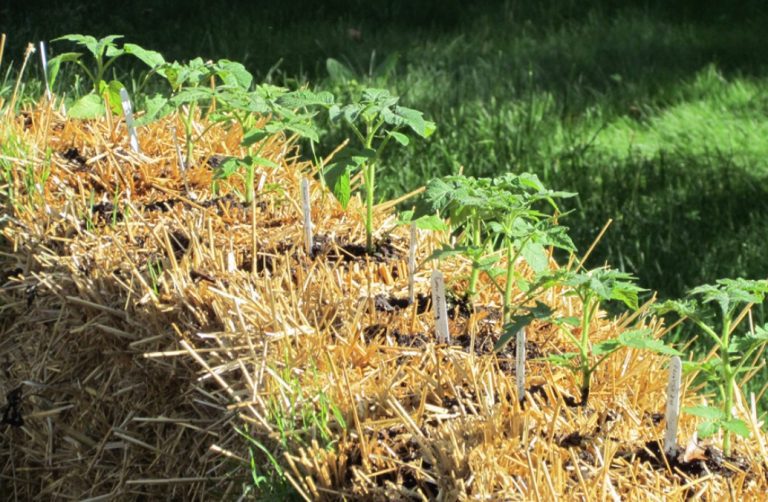
Wondering what to do with old, wet bales and the loose straw created during your home’s construction? There is a good chance you will have a lot of straw left over when you complete your bale build, and straw bale gardening may be the perfect destination for it.
If you did your estimating right, most of it would be in the form of loose straw. You will be amazed at just how much loose straw is produced on a straw bale building site!
It is worth noting that this loose straw is dangerous to the entire project as it poses the highest fire risk of any building material on site. Dry, loose piles of straw can catch fire easily!
Be sure to move it away from your structure during your build process and keep a clean job site. Piles of loose straw are also slippery trip hazards, and it is unbelievable how easily tools can disappear into them!
But what to do with it all the loose straw produced?
Straw Bale Gardening - Loose Straw
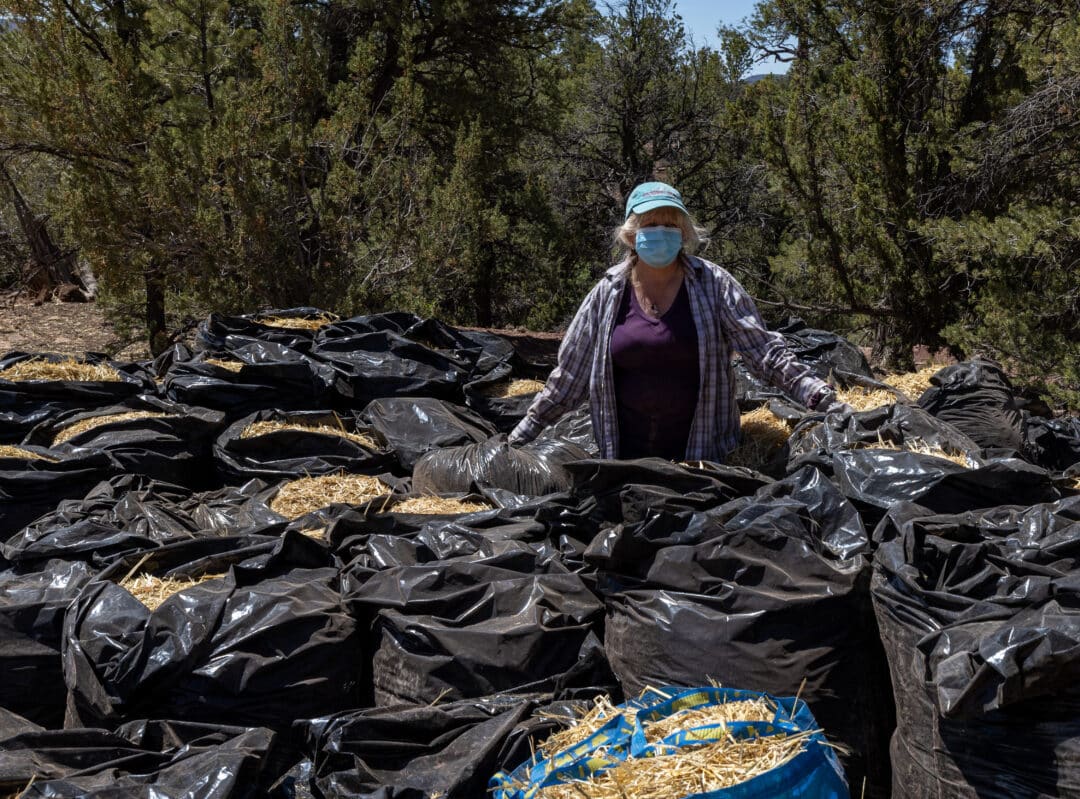
The best destination for loose straw, wet bales, or those suspect straw bales that weren’t of good quality enough for wall installation is to go into growing things! Use the straw in your garden as mulch. Use it to plant potatoes. Spread around to simply decay back into the soil. Use it to make compost, especially if you have chickens.
Speaking of chickens… use it as chicken bedding or for other livestock. There are so many wonderful uses for the “waste straw” that it really isn’t waste at all. Not too many conventional building materials can honestly make a claim such as that!
If you do not have the space to make use of all of the straw, try contacting your local farmers, check in with neighbors, or ask your nearby community gardens coordinator if they could use the extra mulch. Many, especially those who grow vegetables on small-scale farms, will be thrilled to have free mulch.
Some farmers make organic compost that needs straw as one of many ingredients in their mixes. The point is the loose straw is never truly wasted if you take the time to find a good home for it.
Straw Bale Gardening - Leftover Construction Bales
Now what about the leftover ‘good’ bales? These might include the partial bales from re-shaping or those included in the 10% extra we recommend when ordering bales (because it is WAY better to have a few too many than come up short!)
Learn more about calculating how many straw bales are needed in your build here.
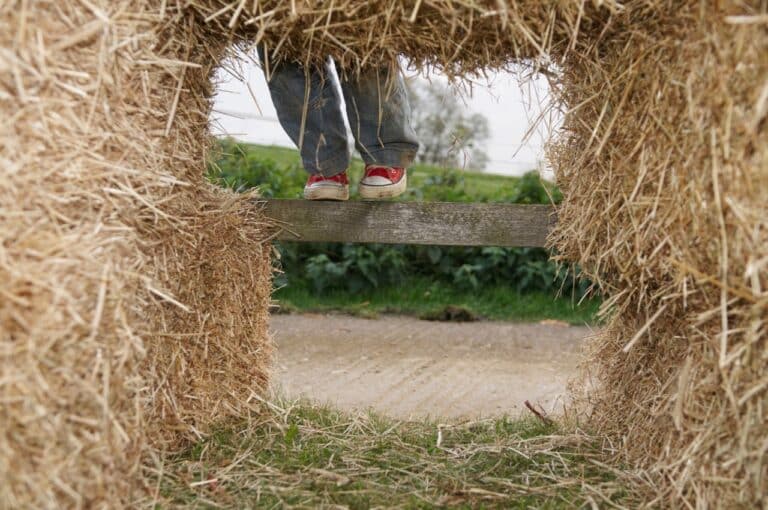
Extra bales on the job site are great to have around as steps, workbenches, or scaffolding supports when plastering.
If the bales are in good condition for construction but were not used, you might be able to sell them to someone interested in building or in need of bales for something else. Or, consider a landscape wall for your own yard!
If you have just a few bales remaining, you could use them as planters. It’s actually pretty cool and a great way to grow plants in limited space or deal with poor soil. It also helps if you have difficulty bending over as the bales lift the plants 18″ or so off the ground.
Carve out holes in the top of the bales and plant directly into the bales. The straw keeps the roots insulated, moist, and slows the breakdown of the bales while providing food for the plants.
In addition, the roots have free run of the place throughout the bale, making a stronger plant. When you are ready to harvest the plant for the last time, you can throw the whole planter into the compost and begin the cycle for next year!
Here’s an example of a potato garden in straw bales and a great learning resource on getting started in straw bale gardening.
Of course, you can do plenty of other ideas with bales. Build the kids a fort. Protect areas from runoff. Build a garden seat. Be creative and have fun!
28 Responses
You could also experiment with cob, of which straw is a primary ingredient. Even if you’re not building a house with the stuff, it still makes fine benches and outdoor pizza ovens and any number of things…
TC,
I do not do a lot of work with cob, so this may be an obvious question. Would it not be a bad idea to use wet straw in the cob? I know that the straw will get wet anyone once placed in the cob, but it seems like old, degrading straw would be a bad ingredient. Let me know your thoughts.
I was responding more to the body of your post than to the title. You’re right, wet straw would not be a great choice for cob, but then I wouldn’t use it for a kid’s fort or a garden wall either. The loose dry straw you said would be a fire hazard around the building site would be fine for cob, as well as any leftover bales. But once wet, composting it would probably be easiest, or the planters you mentioned would be a great idea.
Good point TC. I did not intend for the wet straw to be used in the garden walls or the fort either. Sometimes written word can be misleading when the intention behind the words does not translate. Thanks for the clarity.
Andrew
Ever thought of making mini-bales for interior walls??
Someone has a mini baler, I’ve seen tiny bales in Halloween decorations wire and all.
Hi Stuart, I’ve never considered using small decorative bales for interior walls. There are alternative products to straw bales I usually lean toward for insulating interior walls. Interesting idea, though. I’ll keep Hobby Lobby in mind next time it comes up.
I still don’t see an answer to my problem . . . old, mouldy, damp, heavy bales of straw used for last year’s halloween, how with mould/mushrooms growing from them. Can such be mixed in with other composting materials or would it ruin the compost you have already been carefully developing? If not compost, is there anything safe to do with them? If not, what would be the best place to dispose of them so as not to create a threat to anyone.
thanks, chuck
Should be fine to add to your compost; just be aware of your nitrogen levels, etc…
WET STRAW!!! I am taking care of stray and ferel animals and bought straw to protect them in the FEEZING weather. Now it is back to raining here in Seattle, WA. I know nothing about straw and I am trying to figure out how it can now be used for the pets. I do not have money to loose. The pets are still cold and miserealbe. I am looking for all information on STRAW and now that it is getting rained on, all infomration abou WET STRAW. Please help, thank you.
Hi Veronica. Unfortunately, once bales get really wet, there isn’t much you can do with them. You can try getting them up off of the ground onto some pallets and turn them on their sides to drain out. You will need to get them out of the rain, obviously. Keep a close eye on them though as once wet, they can start to decompose from the inside out, producing heat. This can cause them to burst into flames! This is ONLY a problem when they get completely saturated and wet as a little water can often be drained off. If they don’t drain, you can cut them open and allow them to dry “open air” style. Then the straw can be used as bedding, once dry.
Use that heat! I compost old chicken bedding (straw, wood chips, & shredded paper) in a corner of the coop for wintertime heat. Veronica you can set up the right sized bin with free wood pallets, put unusable straw & other compost in there, cover it with a layer of clean straw or shredded paper, and loosely tarp it : instant warm dry spot for outdoor animals.
Thanks for sharing, Lawren.
A farmer near us died and left his farm to a nephew who bailed hay (about 8 huge round bales). He’s living in New York and we’re in Virginia. He put the bales on our property and has no interest in them or the farm. The bales have been there for over a year. Is there any use for them? We’re building a new home and would love to be rid of them.
Not from a building perspective as they are rounds and have been in the weather. You could sell them or even give them away to someone looking for straw as erosion control. Landfills use straw to as a means to keep debris down. You might contact your local sanitation department and see if they want them…they haul. Good luck.
I keep trying to find any info on the pH of Straw Bales. Because our pH is jumping all over the map depending on where we measure it in the bale.
Not sure about the pH of straw. Are you sure it is not related to the plaster? That is more common as the pH changes as the plaster cures.
We have mushroo.s,growing out of our bale of What? Where can we dump it????
You can dispose of straw bales pretty much anywhere on your property since they are organic material. Just cut the strings and spread the bale out. Leaving it in tact will slow the decomposition down significantly.
we hv 22 bales of straw used for a wedding last wkend. they were in the rain on monday, but now in the sun. we wanted to donate them to a sanctuary for bedding. do u think they will be dry enough to use for bedding for pigs, goats, chickens, after sitting in sun for 2 days? we r turning them as the sides dry
Hi Cindy. Once bales get wet, it’s really hard to dry them out. You may want to tip them on their sides and elevate them off of the ground to help them drain. If someone uses them soon for bedding, then it will be fine. If they wait, there’s a chance that mold growth could occur inside the bale which would make them bad for bedding or most uses. They could still be used for someone interested in straw bale gardening. Cheers and congratulations on the wedding!!!
Hi there. I have a muddy spot right off my porch where my dog does her #1, under a tree none the less. Can I lay out the Halloween/Christmas straw there to help soak up the access wetness from all the above?
I think I know your answer, I still wanna hear it…
Thanks so much
Sure can!
Hi, Ive inharited a barn and the loft has stew in it. There is an opening that is not closed that used to have a sliding door on it. Ive been told the straw is there to keep moisture out of the barn. Ive also read of the hazard of fire with wet bales. Do I need to keep the straw in the barn or can i remove it? Is there a hazard of keeping it in the loft. It looks like it has been there a while.
Thanks
Hi Carrie. That’s outside of my knowledge. To me, that sounds like something you would want to ask a farmer about. There are lots of nuances to farming that I don’t know, so I’d hate to tell you the wrong thing on this one. Good luck.
I am taking my used bales from this year and spreading them on the rest of my garden. Can I wait until spring to rototill it in the dirt? I Golding want to cause a fungus under the snow unless that is what should happen when the straw breaks down. Please respond if you can.
Hi Sue. I am not the expert you are looking for when it comes to using straw in the ground. If you have questions about how to build a house with bales, I’m your man! This was simply a post to help people find reasonable uses for extra bales they may have on site after building their house. Good luck.
Leftover straw is EXCELLENT for mushroom cultivation! Mix it with hardwood mulch, inoculate with wine cap spawn, and you’ll have gourmet edible mushrooms in a season! Oysters will love it, too. The best part: the “waste” product of outdoor mushroom cultivation is compost – and the mushrooms may even stick around your home/area for years to come.
Fantastic, share, Robbe! Sounds like a win, win, win.