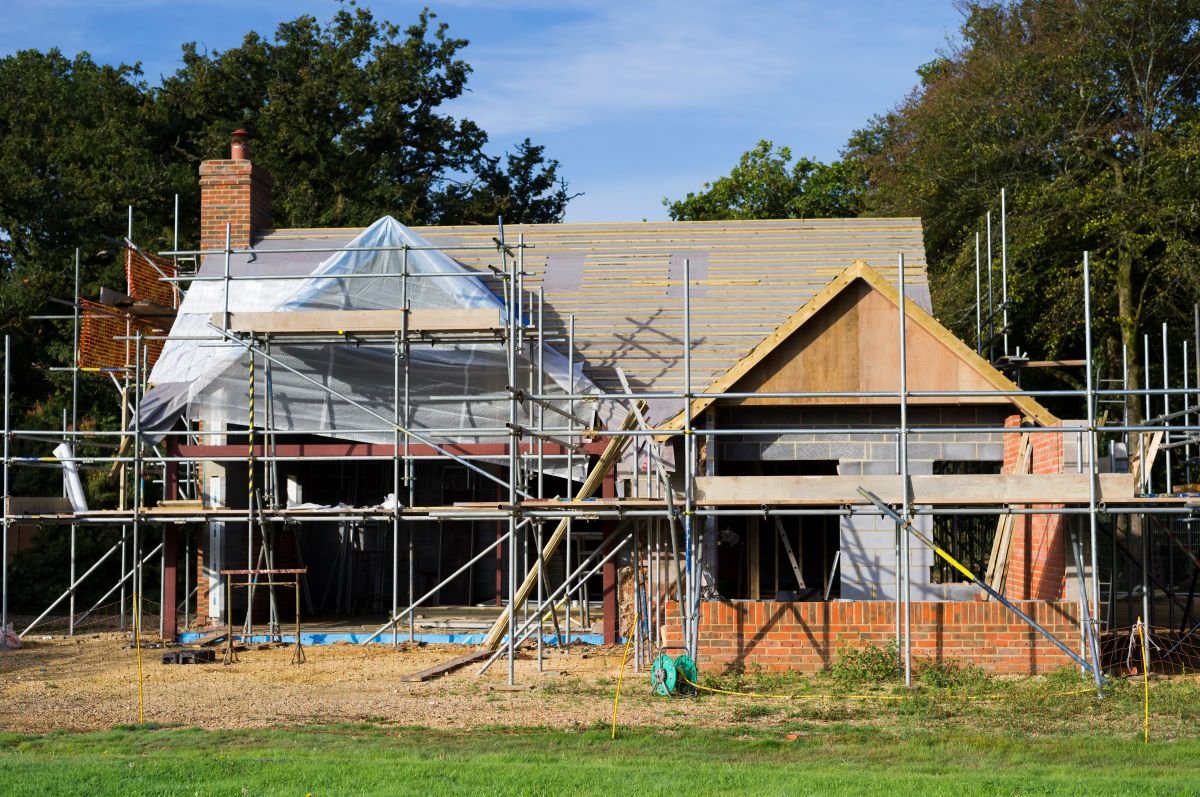
I was recently asked about the viability of retrofitting an existing structure with straw bales. I get that question a lot and figured it was time to blog about it. Any structure can be wrapped with bales, it is simply a question of how much extra work will be required to make that structure function properly once wrapped. Consider that you will be adding about 2′ to the exterior of the house and that all bale walls need to have adequate roof overhangs to protect them from rain. So, unless your house originally had 4′ overhangs, you will have to extend the roof to accommodate the bales. This means opening up the roof system and “sistering” new rafters to the old ones with enough attachment to support the cantilevered rafter tails. A good rule of thumb is that should be a two to one. If the overhang is 2′ then the attachment needs to be at least 4′ long. Of course then the sheathing will need to be attached and the roofing material feathered back into the existing roof.
Another area of concern are the window and door openings. These will end up recessed into the wall by the thickness of the bales, leaving a large sill that could collect water. Your options here are to move the windows and doors to the outside of the wall using standard bucks, or to slope the sills and cover them with some protective material that will quickly drain any water away from the house. Some options are concrete, granite, or finished wood sills. Doors don’t have this option because they don’t have room for sills.
Finally, will the bales collect moisture against the existing building? If the building is wrapped in a non breathable material like metal siding, the chances are high that the bales will end up soaking in the moisture that collects against the metal surface. A drainage system is a good idea in this case. Something like the product on this website (www.mortarnet.com) is a good idea in this application. Regardless of whether the back of the bales is separated from the existing structure by a drainage channel, the bales need to be fire proofed which means a layer of plaster needs to be added to the bales. This is easy on the face of the new wall, but the back of the bales will not be accessible once the bales are installed. For that reason, each bale needs to have plaster or a clay slip applied to the back before it is installed. This is a slow process, but an important one. The bales could otherwise present a fire risk if not covered. This is most important when using the drainage system but should also be done without a drainage system for added protection.
It sounds like a lot of work, but the results are beautiful and efficient. You may have to work hard to accomplish the wrap, but you will be paid back for years and years with lower utility bills, a more beautiful home, and a higher resale value should you ever decide to leave. I hope this gives you some ideas of what is needed for a bale retrofit.
About the Author
Andrew Morison is a specialist in straw bale and green construction. He has shown thousands of people how to build their own straw bale projects through his comprehensive series of instructional straw bale, concrete foundation, and plastering DVDs. You can check these out at www.LearnStrawBale.com..
Email Updates
To be notified of new entries and to get our "7 Essential Steps to Straw Bale Success e-course" absolutely free, enter your email address below then check your inbox to confirm. More Info>>

June 21st, 2008 at 12:52 am
Hi Andrew,
We are considering retrofitting and wrapping the outside of our house that we built. The house is not fully finished yet so it would be a good time for us to do this and get the added insulation. We are currently finishing off the inside and have not put any siding on yet so the plywood is still exposed, we have wrapped with Tyvek but that would be easy enough to remove. If we wrapped with bales the roof overhangs and door and window openings would not be a problem for us so the question we have is regarding the bales going against the wood exterior walls. Would a drainage system such as a mortar net system still be a good idea in this case? Or would just applying a clay slip to the back of the bales and pressing it against the wood be a safe option?
Thanks!
July 3rd, 2008 at 9:55 am
Kirk,
Sorry for the delay in responding to this question. Somehow I missed it. I would use the mortar net AND apply a slip to the back of the bales. The slip is for fire protection, the net is for drainage of potential condensation. Be sure to move your windows to the exterior of the bales as well so you don’t have deep EXTERIOR window sills.
January 29th, 2009 at 11:11 am
Andrew- thanks for putting this site up! What a wealth of info. We bough an older house in ND that needs severe insulation help. It has vinyl siding which I’m planning to take off and surround with SBs. Couple of questions. Do I need exterior framing to hold the bales up and, if not, do they attach to the wall somehow? How are exterior window frames held in place? Is there is a place on your site or a book you would recommend that deals specifically with retrofitting issues? Much thanks and looking forward to being warmer NEXT winter. Greg
January 30th, 2009 at 9:37 am
Greg,
The bales will need to be supported on something, preferably a foundation that gets them up off of the ground. The bales should be attached to the walls at every course level by stapling a folded piece of plaster lath to the wall and then landscape pinning it to the top of the bales. I thought I had more on the blog about retrofitting. You can try searching at the top of the home page. If not, I don’t know of any great resources for the topic. I can answer some specific questions you have here if that helps. Also, I am available as a consultant as well should you decide to move forward with your project.
February 9th, 2009 at 4:57 am
Hi, Andrew
I’ve spent alot of time on your website. I am contemplating converting an existing cinderblock structure (auto garage) into a single family dwelling. I figured since it has lots of interior space I could manage to sacrifice two feet of infill insulation on the inside of the structure – thereby avoiding an additional roof overhang as well as requiring no window and door bucks.
I understand that the infill solution requires stucco or plaster on both sides for fire and rodent protection, but I’m not clear on the moisture concern. I’m afraid I don’t quite understand the mechanics of air movement and moisture/condensation build-up for exterior walls. I certainly don’t want to introduce mold that effectively would be impossible to repair.
If you’re wondering, my intention is to fashion several vertical stands of stick & bale insulation ‘blocks’ with plaster pre-applied to both sides, then fasten and seal them at the vertical seams. (Although I haven’t figured out what capping system is needed at the ceiling yet – thoughts?).
You suggested Mortar Net and other drainage techniques, but I wonder if an interior application of infill would require nothing more than a vapour barrier between the cindercrete and infill straw bales (keeping the cold and warm air separate from each other to solve condensation) – and the interior heat inside the structure would allow the straw bales to remain relatively dry. Would this imply that an airspace would not be required?
Given the permit requirements for residential construction, I totally understand that a contractor or engineer would have expertise in this area, but also given the bleak industry knowledge in straw bale construction, I figured you’d have as much or more to offer.
thanks and great website!
Quentin
February 9th, 2009 at 9:40 am
This is a great situation to explore and I want to admit up front, that I am not a condensation expert. I know that block is quite breathable. I know that water leaks through it all the time in underground applications. I do not know whether or not that would allow for the moisture to move through it from a bale wall. I get the concern about the col meeting the warm and there being a place of condensation where they meet. Plastic will not solve the problem though. In fact, it will likely make it worse. Moisture from inside the home will inevitably push through the bales and hit the plastic where it will get rapped and sucked into the dry bales. My personal belief is that you will be better off leaving the bale/block transition open and allowing any moisture to drive through the block. I also think you can get away without plastering the back side of the bales. I would stack them tight to the block and use blood lath to attach them to the block wall at each course. By keeping them tight to the block, there is no room for fire to spread and it will allow for more moisture to move out freely. Also, the plaster would be wet upon application and would introduce a LOT of moisture into that questionable area. That’s what I would do.
February 9th, 2009 at 12:42 pm
Thanks, Andrew
You’re effectively suggesting that the existing block can act as a plaster layer? That indeed makes sense, given that there’s no plastic or vapour barrier traditionally used inside the plastered bales either… good call.
So my other question is, what is blood or diamond lath, how to I attach it to the block wall, and what holds the bale stack to either one? Friction? string? Maybe a link to demo video or illustration, since I am terribly spatial oriented and not so ‘sequential’, if you’re pickin’ up what I’m layin’ down…
February 9th, 2009 at 2:57 pm
I hear ya. Blood lath is an expanded metal lath used by plasterers. You can find it at plaster yards or some home supply yards. The lath comes in 2′ x 8′ sheets. I cut it into smaller sections, say 12″ x 18″ and fold it so that it lays 12″ onto the top of the bale and the remaining 6″ is folded up the wall. Then you can attach the lath to the wall with concrete screws and to the top of the bale with 9″ landscape pins. Hope that makes sense. I know I have an image of what I’m talking about somewhere on the site, so you might do a search for attaching lath to posts or something like that. I don’t think I have a video of the concept though. Sorry.
February 9th, 2009 at 3:22 pm
Gotcha, thanks – I totally ‘get’ the description you’ve provided: no illustration needed. I would assume that every other course might have these 12×18″ hangers applied to every bale? or is that excessive?
February 9th, 2009 at 3:36 pm
I usually place them every 4 feet or so on each course. That way every course is tied in.
February 8th, 2010 at 10:28 am
In my suburb, I am not allowed to wrap my house in straw bales. I am allowed on the inside. I have a concrete slab foundation with 4″ walls and outside mostly brick exterior. I live in north texas and was wondering how 12″ thick straw bales would work, since 18″ would drastically cut the sq ft. And what would be the best way to do this. Also, are 12″ bales workable for insulating the attic? Or should there I stick with the 18″? At the moment my attic is simply insulation over wallboard and quite terrible. Thank you!
February 16th, 2010 at 9:29 am
Hi Ellen. 12″ bales will be good; however, you can get pretty darn close in insulation value with regular insulation. For example, a 12″ bale will likely be somewhere around R-27 and you can get R-21 insulation to fit in a 6″ wall. If you are specifically looking for the straw bale look and feel, then it’s worth it; however, you’ll be giving up twice the floor space for only R-7 more of insulation. You might be able to get that last R-7 with some rigid insulation as well and still only use 9″ instead of 12″ + 1 1/2″ of plaster and a lot of labor. I love straw bale, but you might want to go with a simply retrofit in this case for the sake of your floor space. Finally, I don’t like using bales in the attic as the weight requires additional framing to be installed to handle the overload on the frame. I, again, suggest you stick with conventional insulation in the attic. Best of luck.
February 2nd, 2011 at 4:14 pm
Andrew – What do you do about bale compression using this technique?
February 2nd, 2011 at 4:29 pm
Hi Mike. Good question. The best way to deal with it is to plan for it. In other words, make sure you have the ability to apply strapping or some other material to tighten up the walls. What’s even better is to use very tightly compressed bales and then squeeeeeeze them into place along the top end of the building. Because they have no load on them from the structure, the amount of settling will be negligible, especially with very tight bales.