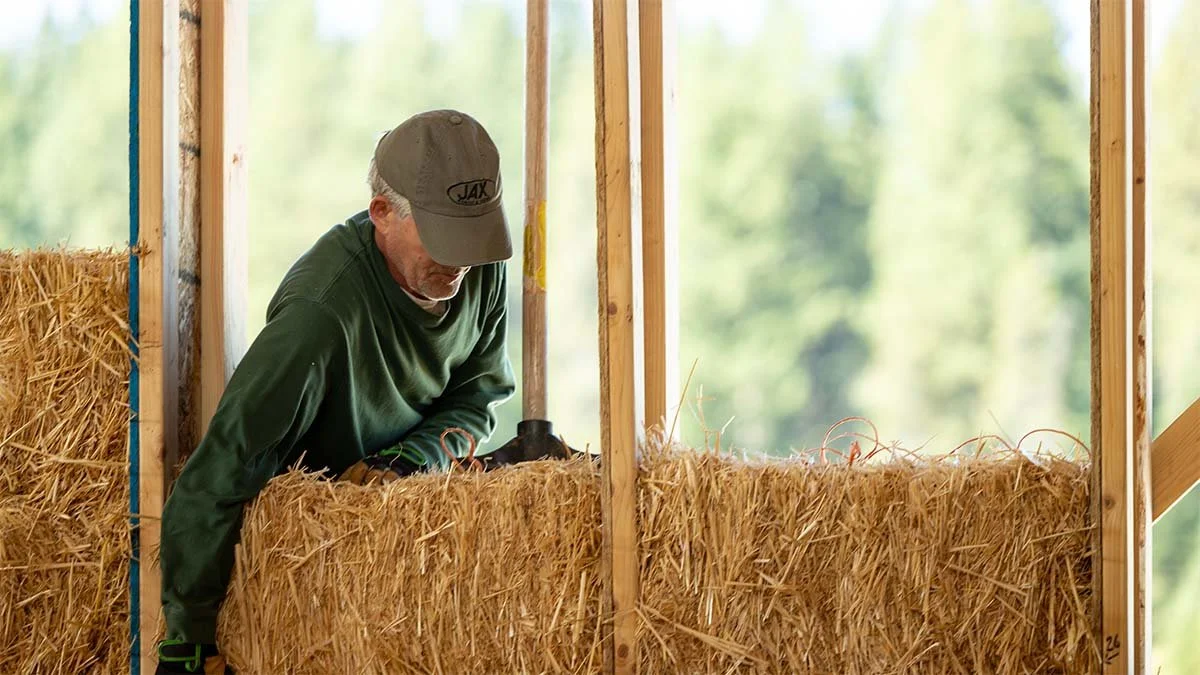
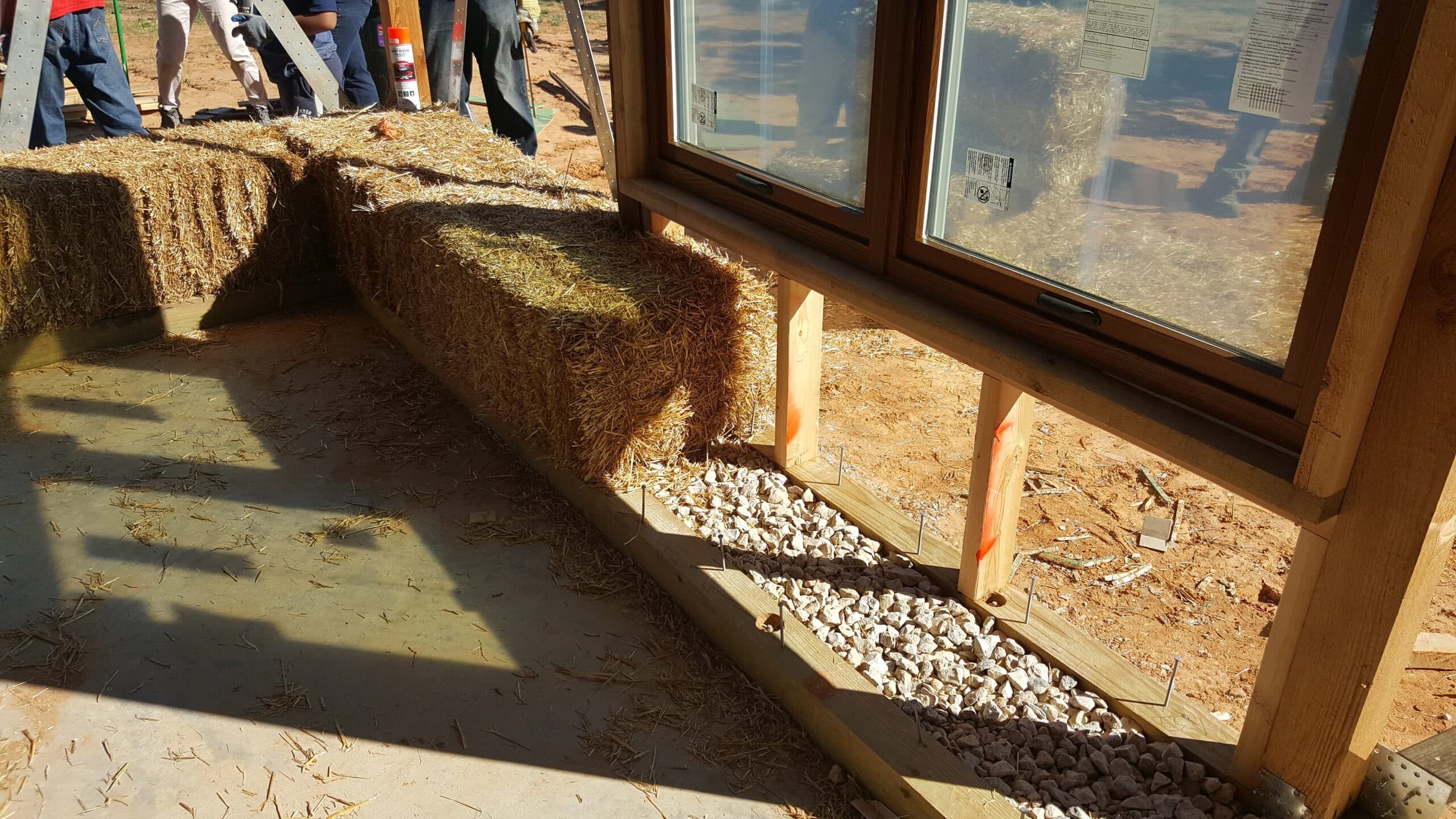
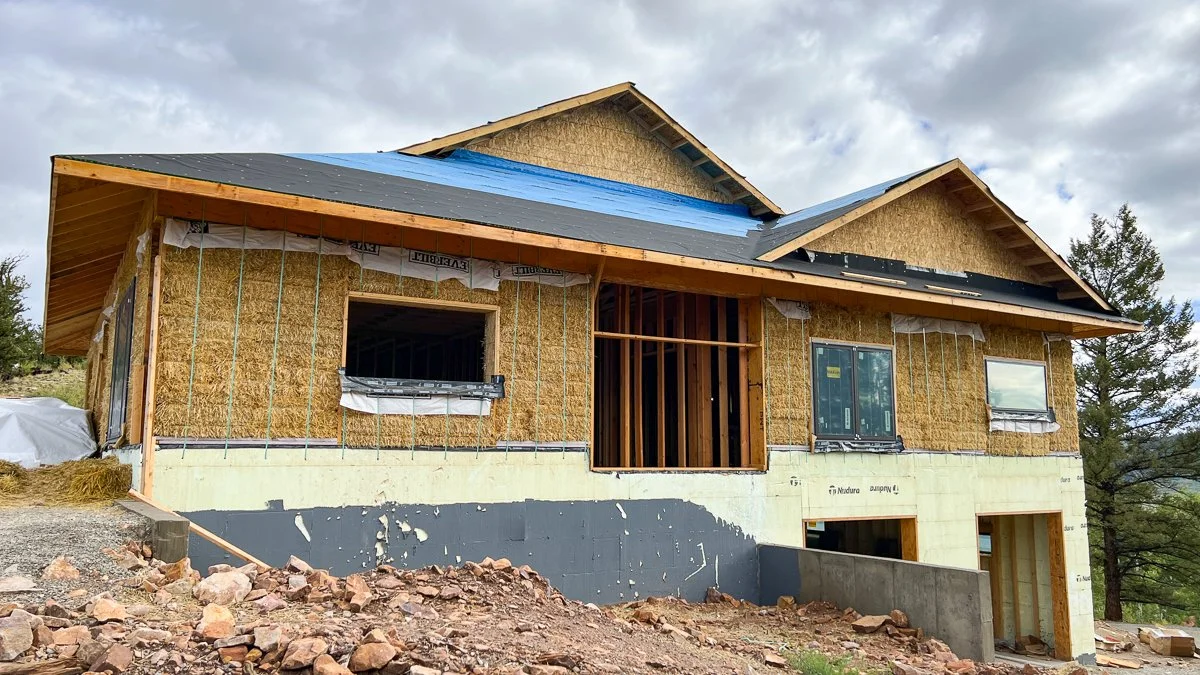
Here is a quick primer on the subject sparked by the following email I recently received. Thanks Josh for the question. This may be obvious to some, but I am no longer surprised by how many people have this very same question. I often hear people use the wrong name for this technology. I hear them talk about hay bale construction or strawbail. The misspelling I can deal with, but the inclusion of hay in the idea of home construction is a problem. In fact, I even heard a builder, claiming to be a straw bale builder, describe his model “hay bale house” when I spoke to him at his booth at the Green Building Expo in San Francisco last year! YIKES!!! I hope that the builders out there know the difference and understand the importance of working with straw. For those many others who have the same question, here’s the breakdown. Actually, here’s the original email question first, then the breakdown.
Josh wrote:
I’m sorry to ask such a simple question but I would really appreciate it if you would explain (on your blog or in a reply email to me) why exactly you cannot use hay to build with. I have ready access to a LOT of hay that is the same price or cheaper then straw in my area. I would like to use some to build a few small structures but I cannot seem to find much information at all about hay. I have read the available information and thus have had some very simple answers but I’m curious if you would provide a relatively thorough answer to
the hay vs straw debate. I need it cleared up so I can share the information myself! Thank you very much! btw – I’m subscribed to your blog and love it!
Here’s my response:
Hay bales are a food source. That is the first and perhaps most important difference. Hay is actually a plant that is cut when it is alive and full of grain. The purpose of the hay is to feed animals. Straw, on the other hand, is simply the stalks of standing plants that contain no grain. The grain is harvested from the plants by a machine that cuts it off of the stalk. The grain is then removed from the field and the stalks are left to die, standing. Once they are totally dead and mostly devoid of moisture, they are cut, raked, and baled. The baled straw has multiple uses. It can be used as animal bedding, erosion control, home building, and more. One thing it is not used for is food. So, the first question to consider is: do you want to build your house out of a food source or something that will not be eaten? I prefer the latter myself.
The next point to be considered is the moisture content of the bales. Pretend that the whole food source thing didn’t matter, just for now. When hay is cut, it is a live plant. That means it has moisture in the entire plant. It is left to dry on the field for a short time and then raked and baled. In that time, some of the moisture leaves the hay, allowing it to be baled without decomposing. We have all heard of bales spontaneously combusting, right? Well, this is due to bales having too much moisture in them. They start to decompose on the inside and that creates heat. That heat increases as the decomposition process increases (cyclically at this point) and then the bales burst into flames from excessive heat. This is a situation where there is obviously too much moisture, yes, but it proves the point I am making in a dramatic fashion. Straw bales have very little moisture content in them when they are baled. This is another difference in material. The lower the moisture content, the less chance of damage to the bales once in the house by either mold or fire from decomposition. In fact, decomposition and mold growth cannot happen in the straw as long as the moisture content is kept below 20%. That is quite high by the way. Most of the bales I use register around 8-9% moisture content to give you an idea.
Finally, the inclusion of the moisture and the seeds can cause something else within the structure that is neither fire nor food: growth! I have seen cob walls where the straw used in the mix had a lot of seed material wrapped up in it. Two days after the plaster was applied, the entire wall started to grow grass! The owners thought it funny, which it was at least to look at; however, this was indicative of a big problem: they had seeds in their walls. This can attract all kinds of pests from mice to cows. In the cob, it was less of a problem but in a bale wall, it could be a disaster.
So, no food, low moisture content, no growth is what makes straw the ideal product. As a great bumper sticker I bought from CASBA (the California Straw Building Association) a few years ago reads: “Hay is for Horses. Straw is for Houses.” I couldn’t say it better myself!
About the Author
Andrew Morison is a specialist in straw bale and green construction. He has shown thousands of people how to build their own straw bale projects through his comprehensive series of instructional straw bale, concrete foundation, and plastering DVDs. You can check these out at http://www.LearnStrawBale.com.com.
Email Updates
To be notified of new entries and to get our "7 Essential Steps to Straw Bale Success e-course" absolutely free, enter your email address below then check your inbox to confirm. More Info>>


October 29th, 2007 at 12:03 pm
Thank you so much! I am now very well informed about the difference in choice. I do of course have quite a bit of hay for our horses and that is precisely where it will continue to go. To the horses. A sod roof would be pretty cool but I’m not so sure the wife wants grass coming out of the walls!
Thanks again for clearing this up for me. Have a beer/lager/coffee on me!
January 26th, 2008 at 11:05 am
I know well the difference between hay and straw, but what I don’t know is the preferable TYPE of straw! Someone told me tha Oat Straw is the best choice and I see you like the organic Oat Mkeal Stout, but what about wheat steaw or barley straw? Can these types of straw be used also? Does one have better insulating properties than the others? I assume the bigger the airspace within the stalk would be the deciding factor but have never seen or read about this variable. Thanks for all the great information, Yours in the Green Zone, Tommani R Sandoz
January 26th, 2008 at 9:23 pm
Tommani,
I believe that the best bales are those that are locally available to you, as long as they are dense, dry, and uniform in shape. Wheat, barley, oat, rice, hemp, cardboard…anything that can meet the requirements for density, moisture, and shape will work fine.
October 20th, 2008 at 4:50 pm
Andrew,
We are putting some great straw in our walls now but every once in awhile we run into a bale with what appears to be some dried grass in it. Those bales appear green in color here and there, within the obvious straw. Is this an issue? Should we avoid those bales and remove the ones that got put in the wall before we plaster?
October 20th, 2008 at 8:07 pm
If you can easily remove the bales with the obvious grass, I would. I would also not use any with green grass in them moving forward. It will likely not be a problem, but why take the risk? Good catch!
November 5th, 2008 at 3:28 pm
Andrew, we have access to hay that is clean, but to old to be used for feed. I can get it for much less than straw. Local straw dealers charge more than for hay. The hay I am describing comes from costal bermuda, which is a very course grass that produces no seed, as it is sterile. Not moldy and very dry from many years in the cover of a closed barn. Why would it not be usable?
November 11th, 2008 at 1:16 pm
Hmmm. If it is hay, it is a food source. I would suggest you not use it even if it is dry and without seeds.
January 9th, 2009 at 11:29 am
I am looking into building a Strawbale house in North Texas and am concerned about ants, fire ants especially. Will they be a problem?
January 10th, 2009 at 6:37 am
Hi Jill. The ants should not be any more of a problem in a bale house than in a conventional house.
January 23rd, 2009 at 3:47 am
Hello, I was very happy to discover your website today and would like a bit of advice if possible. I am going to have a wooden house built on my land in France. The builder suggested using loose straw as wall and floor insulation. I’ve read some comments from someone on another website who did that it turned into somewhat of a problem both in terms of time and money spent. Also he said that plasterboard had to be used to meet fire regulations (in the UK) and the straw had to be boxed. Any ideas or suggestions?
Many thanks,
Jane
January 23rd, 2009 at 9:55 am
Hi Jane. I would recommend against using loose straw in the walls and floor as it is not the best insulation per cm available and therefore would likely end up being a waste of effort and money. I would suggest cotton insulation if you are trying to stay green. Loose straw is a fire risk and has a relatively low R-value per cm.
January 23rd, 2009 at 4:10 pm
Hello Andrew,
Thanks for your helpful and speedy response. I am a real novice in this field. Could you give me an idea of the cost of cotton insulation and in what application form it comes? Is it appropriate for roof, floor amd wall insulation? I’ve never heard of it being used here in France but of course that doesn’t mean it isn’t.
January 24th, 2009 at 12:29 pm
Cotton insulation is very versatile. Check out this website for a bunch of good information about the product. This is just one of several companies who make cotton insulation. http://www.bondedlogic.com/
November 7th, 2009 at 11:32 pm
This is actually so interesting!
I have a college assignment on ‘hay bale construction’ and couldn’t understand why i could only find info on straw bale… hmmm… seems colleges also make mistakes – and that is scary!
November 8th, 2009 at 8:43 am
That’s funny! You ought to do well on your assignment since you can show the college that you know more about the technique than they do.
January 31st, 2010 at 11:01 am
You see the “square” and the hugh “round” thingys in the fields after harvest. Is one more for straw than for hay? Thanks
February 3rd, 2010 at 11:19 am
It depends on what’s harvested. The large round bales can be either hay or straw. It’s best to ask the farmer directly. Either way, you want smaller bales, so start by finding a good local source of 2 string or 3 string bales. You can ask your farmer supply store for leads or go straight to the source by watching fields as they bale and speaking with the farmer directly. I prefer the second, more direct option.
February 4th, 2010 at 2:16 pm
You wrote that the large round bales can be either hay or straw, so can the square bales be either, also?
February 7th, 2010 at 7:59 pm
Sorry. Yes, they can be either as well.
March 16th, 2010 at 7:48 am
Do you know of any architects or engineers in the Upstate South Carolina/Western North Carolina region who may have experience working with straw bales? I cannot get a building permit without one, and so far I haven’t been able to find one.
March 16th, 2010 at 1:34 pm
I don’t of hand. I’d suggest you contact the folks on the links below as they have completed homes in South and North Carolina and could have some information that will help you. Short of that, you can contact Chris Keefe (chris@organicformsdesign.com) and see if he can help you as a designer. He has engineering connections and lots of SB design experience.
South Carolina: http://sbregistry.greenbuilder.com/search.straw?lcou=United%20States&lsta=SC
North Carolina: http://sbregistry.greenbuilder.com/search.straw?lcou=United%20States&lsta=NC