
Tropical Climates and Straw Bale Construction
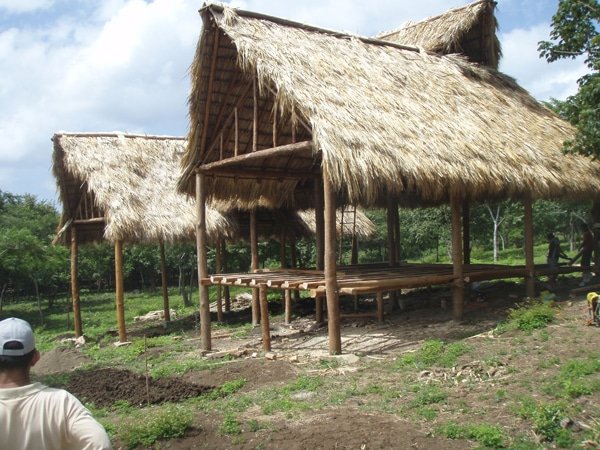
Do you live in a tropical rainforest?
I am a big believer in the merits of straw bale construction. That's probably obvious by now; however, there is one significant drawback to working with bales: climate conditions. Bale homes are ideal for dry and mostly dry climates, acceptable in wet climates, and challenging to deal with in very wet and humid climates. So what about tropical climates and straw bale construction?
The big demon is not water, in the form of rain, at least. Instead, it is humidity.
Rain can be handled with proper design so even the wettest climates can accommodate straw bale structures.
Humidity, on the other hand, cannot easily be designed out of a structure. It pervades everything and gets into everything. A bale house can stay dry from rain and still be saturated with moisture inside the plaster due to the acclimation of the bales to the area's relative humidity. Everything eventually settles on a moisture content that is in direct relation to the relative humidity of its surroundings. Therefore, if the humidity is high, so too is the moisture content of your bread, your clothes, and your bales!
Let me give you an example: I lived in Northern California, where humidity was often very high due to the coastal fog. My wife put her leather boots under our bed for a month, and when she took them out, they were covered in green mold! Our house seemed fine, and we surely did not expect to see that kind of mold anywhere near the inside of our home. But, the space under the bed is dark and has limited air movement, kind of like the space in between your layers of plaster.
What to do? Well, you must first consider if your climate is right for straw bale construction.
If you have really high humidity and very little dry season each year, you may want to consider something other than bale construction.
Another option is to consider mechanical help. If you install a whole-house dehumidifier, you can minimize the amount of moisture in your house and, therefore, in your bales. Remember that when pressurized under normal living conditions, air moves out through the walls. If the air is dry, it is safe to pass through the walls. Systems like this can be installed into your HVAC system, if you have one, or can be stand-alone units utilizing 4" ductwork.
Remember to design and build for the water and humidity. You not only need to design to keep water out but also to allow it to escape should it get in (nature has a way of blowing even the greatest plans!)
Plan for both, and you will be okay. Nevertheless, if you live somewhere that you think is too risky, ask for advice and then make whatever decision you feel is best regarding the use of bales in your home. And know that this is coming from someone who loves bale construction, so I'm trying to talk you out of your dream!
-Andrew Morrison