Straw Bale Construction - How to Retie Bales to Custom Sizes
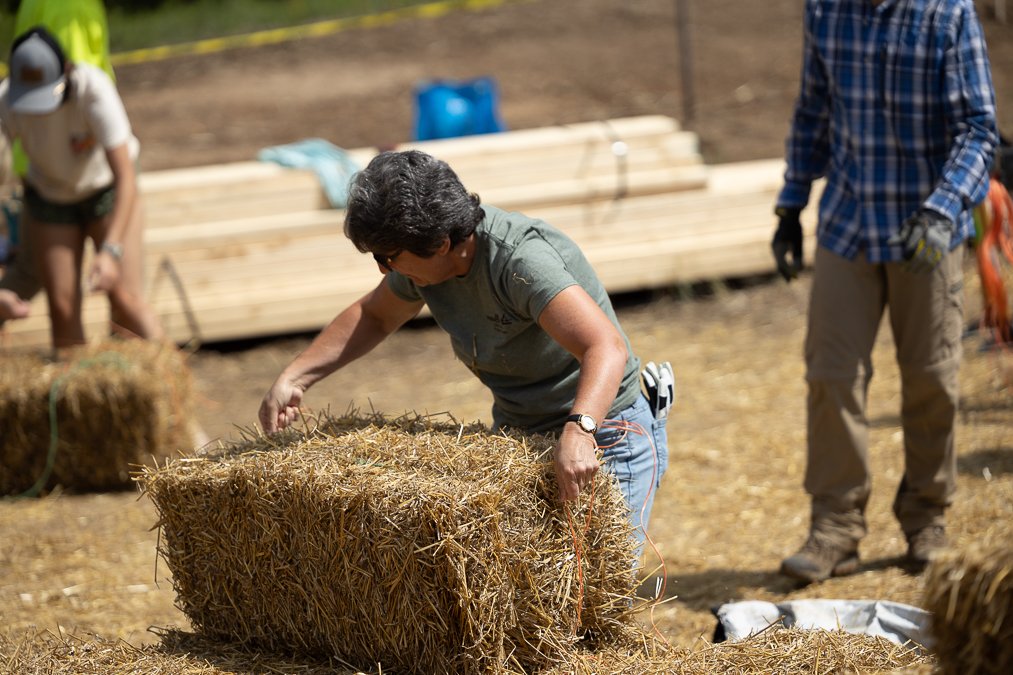
Measuring a bale length for resizing at a strawbale.com workshop
Retying straw bales is one of the most important skills to be proficient in on a straw bale construction job site. Depending on your home design and bale quality, you may retie 10% to 100% of your bales to get the size needed for your walls.
(OK, hopefully not 100%! But if the bales don’t come from the farm tightly baled for good density, it is an unfortunate possibility. More about choosing bales for straw bale construction.)
Getting even a few minutes faster on each bale can easily save hours of labor. The quicker a builder can retie a bale, the smoother the baling process will flow.
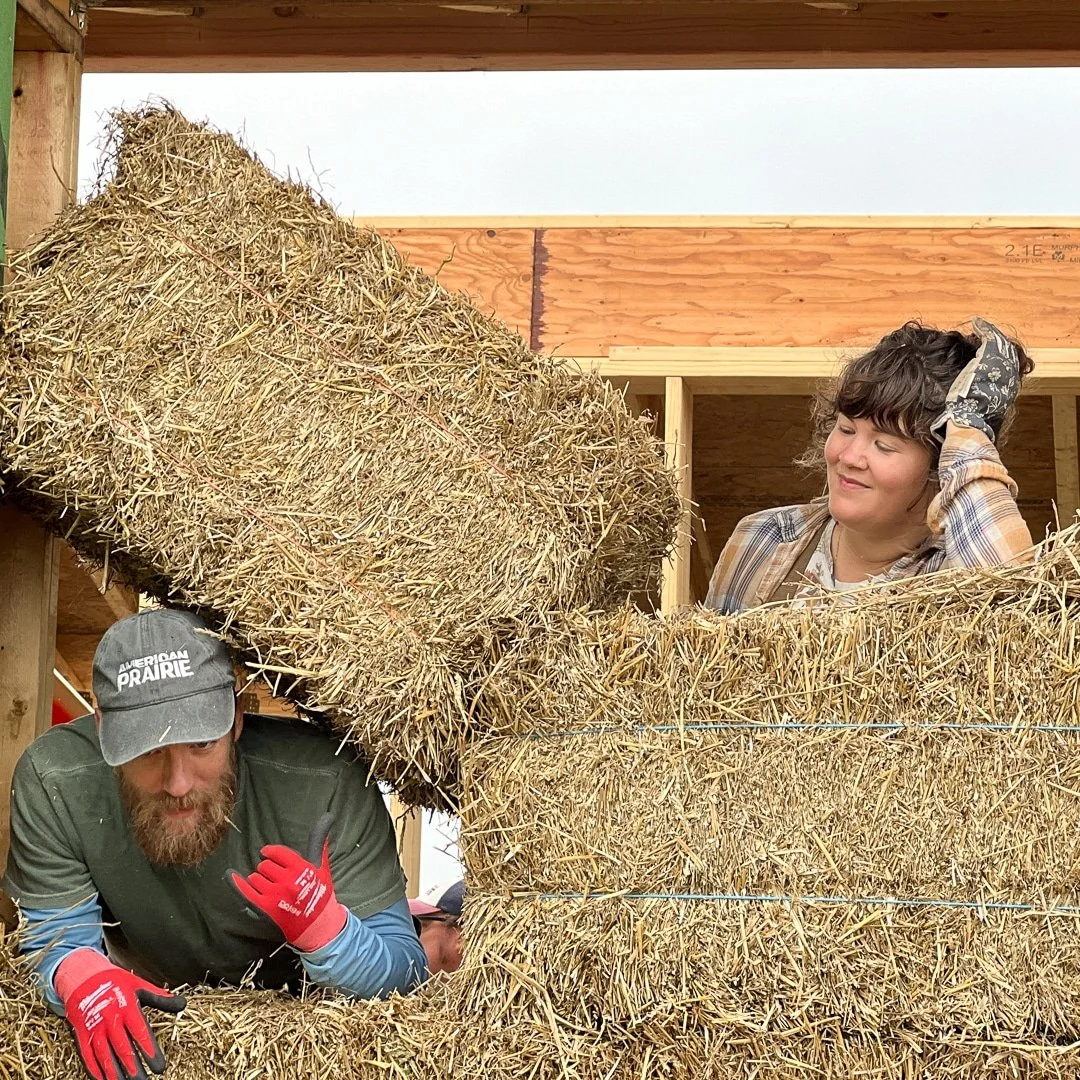
Workshop fun!

Straw bales setup as a work bench.
Setup and Tools for Straw Bale Construction Bale Retying
Retying is a part of building with bales that can frustrate even seasoned builders. Everyone has likely had the experience of retying a bale and crossing the strings, thus creating two tangled bales. You can avoid this with the right baling needle and the right techniques.
Step one is to have everything you need at hand to retie bales to custom sizes. You’ll need baling twine, two bales to form a work table, a Knife, measuring tape, and, most importantly, a quality bale needle.

Let’s Talk Bale Needles
A quality baling needle allows you to place force through a comfortable handle directly in line with the needle, making it easy to ‘steer’ the needle through the bale to the other side in a straight line. It must be made of strong, smooth metal so that it slides through the bale and does not get bent or misdirected by the resistance of the densely packed straw.
The needle will also have ‘push’ and ‘pull’ grooves cut into the pointy business end. Unlike a regular sewing needle, the twine is hooked into these grooves instead of being threaded through. This is one of the key characteristics that help speed up your process. We suggest having 2-4 bale needles handy on a build.
Well-built, thoughtfully designed needles can ease the process and reduce moments of struggle. Years of straw bale construction and workshops have driven this point home (pun intended!), and we use a specific needle design at every workshop.
You can get the same bale needle design schematics here. They come with a bonus guide on Custom Bale Shaping plus the schematic design for the Tensioning Fork used with the wire mesh specified in many modern straw bale home designs. You can take the schematic drawings to a local metal worker or have some DIY fun by building them yourself.
“The pull groove is great for sewing bale walls. Once the needle is pushed through the wall, the twine can be laid in the groove and the needle pulled back through. Want to go even faster? Use two needles and work as a team when sewing. ”

Workshop participants learning to tie the bale knot the fast method.
Learn Specialty Bale Knots and Watch How To Retie Bales, 3-part Video Series
Here’s a series of short videos to help explain efficient techniques for retying bales from the Founder of Strawbale.com, Andrew Morrison, and a NEW 3rd video with a close-up of the Bale Knot, aka Miller’s Knot, along with a slow-motion look at the newer quick tie method taught at our workshops.
Re-Tying Straw Bales Part 1 of 3 by Andrew Morrison
Watch the techniques for avoiding crossed twine and tangled resized bales. Also, see the workstation setup for good ergonomics and how to make two bales out of one bale quickly and efficiently.
Andrew Morrison does a great job showing other tips, like separating the bales, to save you time and energy. The more you practice, the better you will get. Be patient with yourself, especially with the specialty Bale Knots!
“Be sure you don’t twist the needle as you plunge it through the bale, or you may still find a way to tangle twine! ”
Re-Tying Straw Bales Part 2 of 3 by Andrew Morrison
This is the original, step-by-step tutorial on how to tie a Bale Knot, aka Miller’s Knot. This single technique will save you a lot of headaches during construction.
Most balers are used to using a trucker’s hitch knot, which is an adequate knot but not nearly as fast as the Bale Knot. Learning the new knot may take some time if you are used to tying a trucker’s hitch. Stick with it, and you will be thrilled in the end. We use this knot to speed up bale retying and sewing mesh tight to the walls.
>>NEW in Part 3 is an updated close-up of the Bale Knot, aka Miller’s knot, and a slow motion of the new quick tie method we teach at our workshops.<<
*NEW* Re-Tying Straw Bales Part 3 of 3 by DeeBo
Those of you who have attended a strawbale.com hands-on workshop in recent years know that there is a quick tie technique for the Bale Knot that isn’t shown in Andrew’s earlier videos.
It is faster than a trucker’s hitch and the standard tying method of the Bale Knot, aka Miller’s Knot. Here, it is in slow motion and an updated close-up version of how to tie the Miller’s Knot, as seen in Video 2.
Conclusion

One of the reasons straw bale construction attracts people is that they can actually do the building themselves.
Learning skills that bring efficiency to your build, like how to retie straw bales into custom sizes with the right knots, just makes that sweat equity you invest go that much further per effort and, at least for us, more joyful than the struggle bus alternative!
We always teach the latest best practices at our workshops, like the Quick Tie Bale Knot. If you’re looking to try out hands-on straw bale construction skills while creating memories and friendships to last a lifetime...
Make this the year you take a huge step forward on your straw bale home dream and join us at a workshop experience! See our current workshop schedule here.
FAQ
What is straw bale construction? Straw bale construction is a building technology that utilizes straw bales (typically comprised of the dried stalks of grain crops such as wheat, rye, barley, or rice) as the insulative material for the building’s walls and can also sometimes be used as structural elements.
What is baling twine? In straw bale construction, baling twine refers to the small-diameter cordage that binds the straw into a bale. For construction purposes, nylon baling twine is most recommended; however, sisal is another material from which it is made. Baling twine comes in different weights for strength and colors. See an example here (paid link). Note: Sisal isn’t typically strong enough for retying bales as tightly as needed for straw bale construction.