If you're new here, you may want to subscribe to my RSS feed. Thanks for visiting!
I recently received the following question from a visitor to my blog named Pat. I get this question and variations of it quite often. Here is the question:
I have a house built in 1911, the wood frame is 2×10 and 2×4 pine construction the wood is now so strong that a nail must have a pilot hole drilled first. Is it possible to add additions to this house using straw bale construction and tie the two together somehow? I live in Minnesota so I love the high R value of bale construction. I had also thought about completely encompassing the whole house and slowly removing the exterior of the existing house. The purpose would be to allow us to live here while we are building the additions. If you have done this how did or would you do it?
Here’s my answer
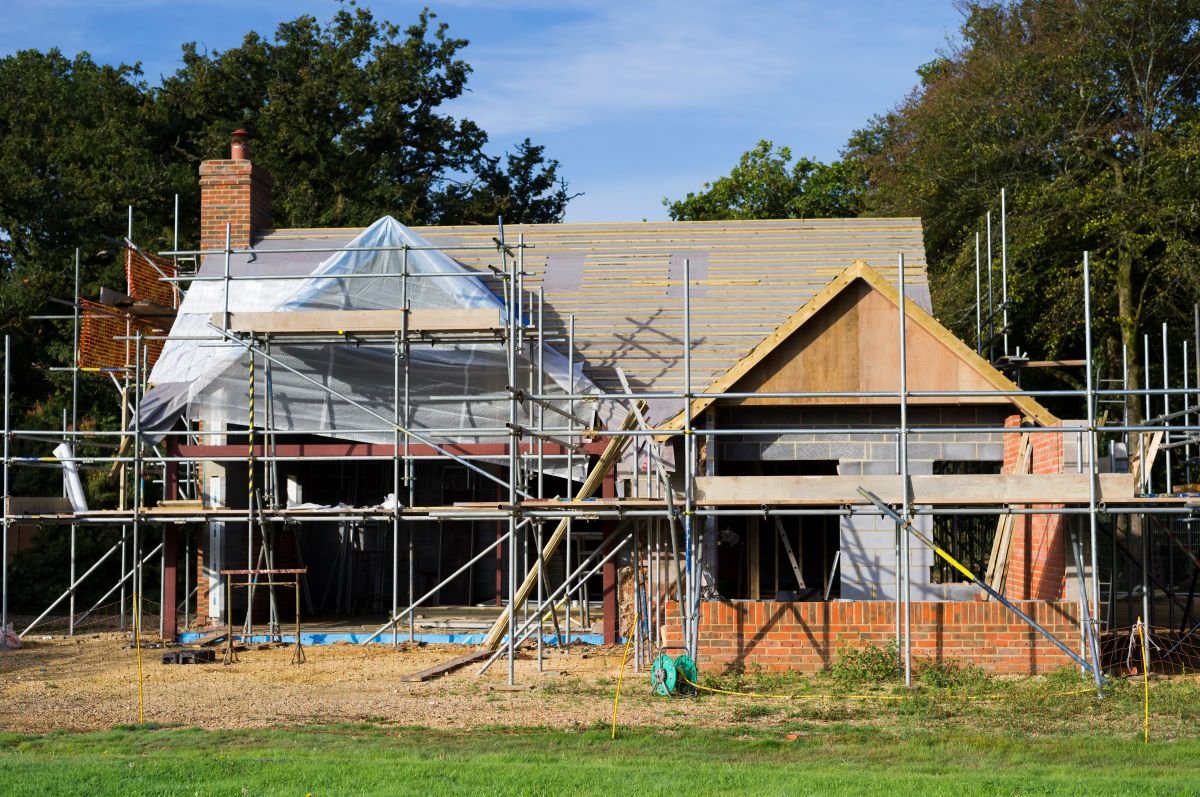
The idea of wrapping the house in bales is a common one and sounds like it would be a good idea in Pat’s climate. I have attached a video below that discusses three of the major areas of concern when working with wrapping an existing house with bales.
When attaching a straw bale addition to an existing house, the biggest concern is to make sure that the two structures are tied together well. The easiest way to do this is with expanded metal lath at each course. Lay a swath of lath on top of the bales and pin it to the top of the bale surface with dowels or landscape pins, the latter being easier. Then bend the lath up at a 90 degree angle and staple it to the framing of the existing house. The two structures are now tied together. Be sure to use lath spanning the face of the joint created between the bales and the existing structure before you plaster because the two building materials will move at different rates under different weather conditions.
Finally, make sure the face of the bales and the face of the existing walls are lined up properly “in plane” so that the finish plaster will not have a bump in the transition. The exact line up depends on the thickness of the plaster on the two substrates and the transition used. Just be aware that some thought will need to go into this before you even form the new foundation. Happy Baling!
Popularity: 79%
Like this? Click here to buy me a Wolaver's Organic Oat Meal Stout!About the Author
Andrew Morison is a licensed contractor specializing in straw bale and green construction. He has shown thousands of people how to build their own straw bale projects through his comprehensive series of instructional straw bale, concrete foundation, and plastering DVDs. You can check these out at http://www.LearnStrawBale.com.
Get Updates of New Articles and Posts
To be notified of new entriesblog entries and articles and to get our "7 Essential Steps to Straw Bale Success e-course" absolutely free, enter your email address below then check your inbox to confirm. More Info>>


November 2nd, 2007 at 6:55 pm
I am about to purchase a single story, stick framed and stuccoed building. I am planning to retrofit the existing walls with straw bales to improve the insulation. I am also planning to change the current roof for a gambrel roof thus giving me an extra floor and the perfect opportunity to create larger overhangs. My question is regarding the finish of the walls. The existing stucco is in excellent shape despite Canadian winters and is very easy on the eye. I was originally planning to cover the bales with 2 coats of plaster and then clad them with wood siding in areas where large overhangs may not be possible but with the original stucco performing so well would it be feasible to use a commercial stucco product to finish the bales? If not, what is the best way to attach the siding?
November 2nd, 2007 at 7:01 pm
Andrew,
You can use conventional stucco only if the climate is relatively dry (in terms of humidity, not rain). The stucco does not breathe very well and so you may need to install a de-humidifier in the house to help regulate the humidity levels. If you decide to install siding, you will need to “let-in” wood studs on the exterior of the bales or frame the bale portion with 2x material 2 feet on center. That is necessary to support the siding on a maximum of 2′ intervals. Be sure to check out the video in the above post if you have not already. It discusses another potential need: ventilation behind the siding. This may not be necessary, but it will depend on how tight your siding is. Good luck!
November 2nd, 2007 at 7:23 pm
What about building a straw bale house with a cob wall or other thermal wall? How would you attach the bale walls to the cob wall or, even harder, to a cement block wall? Thanks.
November 2nd, 2007 at 7:29 pm
Cindy,
Attaching bales to cement block is not that different from attaching bales to wood. The big difference is in the anchors used. On wood, nails or staples can be used; however, for the cement block, specific concrete screws or anchors must be used. It may be best to use two anchors or screws and a small piece of metal between them to fully hold down the lath. You can find the anchors or screws that are needed at any quality hardware store. I don’t work with cob, so I can’t answer that part of the question.
Erik
November 3rd, 2007 at 8:20 pm
I work with cob a fair amount and I thin the way to go would be to anchor the bales to the cob with mesh or dowels laid in between each coarse of bales. That mesh or dowels would then be incorporated into the cob as it is built. It would depend on how the walls are built as to when the material is laid. The best option would be to build the bales and th e cob at the same time. The problem here is that the bales will go up considerably faster than the cob, so you will have to plan for the timing to match up.
Chris
November 3rd, 2007 at 8:25 pm
I like this idea. Can I wrap my house which is a single wide mobile home with bales? Would I need to use the mortar net stuff you mention or could I put the bales right up to the existing outside of the house? Thanks.
November 3rd, 2007 at 10:04 pm
Adding Bales to an existing Home
Andrew,
In 1998 I have been asked by a Customer if it where possible to fit Strawbales to an existing Home.
I came up with two options:
1) To adapt to the extra width of the bales, build a new roof over he existing one, leaving a space of 100mm between the roofs for insulation purpose (called a tropical roof)
2) Build the wall externally and extending over the existing roof level (Hacienda Stile)
Option 2 has been selected.
We poured a new footing (300×500mm) around the existing dwelling to accommodate the size of the bales.
As a dampcourse we used bitumen on the footings and laid the bales on the sticky tar.
Bitumen is also a white-ant deterrent!
There is no need to render the backside of the bales, since they lay tight to the existing wall.
As reinforcement we used steel mesh (8mmx 200×200) on every 3rd course and fixed to the existing wall with tek-screws (3 per bale) and steel wire. A thin layer of mortar poured onto the mesh adds strength to the wall.
The bales are trimmed on a flat floor on both sides prior to installing. There is also no need of stucco netting since the trimmed bales are a perfect base for the mortar render. Once I had to cut a window into an existing Strawbale dwelling I built years ago. The render was just about impossible to remove from the straw! Straw is hollow and the mortar penetrated up to 15mm into the stalk. The only time we use netting is around openings.
We used an acrylic sealer in the mix to seal the top of the wall.
Rudy Stoffel, Strawbale Construction, Western Ausstralia
November 4th, 2007 at 2:02 pm
I would think that ventilation behind the bales would be needed if there is a non permeable surface that is in contact with the bales. I would be afraid that the bales would suck up any moisture that was collecting against the surface of the walls, like the steel siding of a mobile home for example. If the walls are wood, I don’t imagine it would be a big deal to place the bales tight the walls. I also agree with Rudy that the bales should not need to be “back plastered” if they are installed tight to the existing walls. I don’t see how they would be a fire risk if they are compact against the existing walls, especially if they have been shaved of the loose straw prior to installation.
November 4th, 2007 at 5:44 pm
Frank Monk
I’ve tested the moisture content of the straw after one year (13%) to check the durability of the acrylic sealer on top of the wall. The existing wall of the dwelling has an 80mm cavity and is lined inside with plaster boards, eliminating the chance of condensation entering the Strawbale wall.
November 5th, 2007 at 9:00 am
I appreciate all the comments and the video tip. Very informative. I am wondering though as I have never gotten a straight forward answer on if straw bails work good in all climat zones? I live in a rather humid part of the USA but would like to build a Stawbale home. Is this possible? Also, my wife isn’t particulary fond of the stucco. Can we side the straw bales with any kind of siding? We were looking at the log cabin look with real wood siding, but will vynal siding work as well? Or stone?
Lots of questions, I know but can’t seem to find answers anywhere. Please help. Thanks
November 7th, 2007 at 8:43 am
Straw bale construction can work in many climates; however, high humidity areas are not great for bales. That is not to say that you cannot build with bales in a high humidity area. You will need to consider the use of a whole house de-humidifier and moisture sensors. In terms of siding, you can use other siding applications like wood, but it is a lot more work to do that. In general, it is best to stick with plaster or use a stone veneer that is applied directly to the bales. I would not use vinyl at all as it is an environmental disaster and it would likely trap moisture behind the surface which would harm the bales.
November 10th, 2007 at 11:19 am
On the topic of rock as a siding(I’ve done no masonary work so pour out all the knowledge you see fit): How would a person go about putting rock on strawbale? Would you go with the original clay/lime/sand mix and stick the rock to it? Is there more that needs to be done to hold the rock in place?
November 12th, 2007 at 12:58 pm
The first step is to place a scratch coat on the bales just as if you planned to plaster the whole house. After the scratch coat, you would use a setting compound, which could be the lime plaster, to back butter (put mud on the back of the stone) and butter the wall. Then you would place the stones starting from a straight edge that is screwed to the wall. Be sure to screw the straight edge in a place where a final layer of stone can later be added to the building, once the majority of the wall is complete.
Another option is to start at the top and work down. This is good because you don’t end up spilling mortar on the face of the veneer; however, you have to be sure the mix is right so the veneer does not sag under its own weight.
November 25th, 2007 at 5:32 pm
I have sort of the opposite question to ask. I have an old garage at the back of my property that is basically unused. Just the other day I was looking at it and wondering if I could add a bale structure INSIDE of the existing structure. I like the look of the old garage and wouldn’t mind losing whatever inside square footage might be lost.
Ever since we bought this property I’ve wanted to do something with that old building (like a dedicated home theater building or a studio/office). I live in Minnesota and think the bales would be great in the winter to keep warm.
Would this work?
Looks like a great site, I hope to learn more about straw bale building.
November 27th, 2007 at 7:36 am
Phil,
You most definitely can install bales inside an existing structure. The hardest part is getting the bales to attach to the framing since most structures are built with studs 16″ or 24″ on center. That makes for a lot of notching. You can simply stack the bales against the studs and use plaster lath at each course to attach the bales to the frame. This is labor intensive, but less so than all the notching. You will also need to apply some mud (clay slip or thin plaster) to the back of the bales so that fire cannot spread up the face of the wall against the framing. You can then pack light straw clay behind the bales and into the stud bays. Depending on the climate, you may need to add a ventilation area between the bales and the exterior wall to stop moisture from getting trapped there and sucked into the bales. I think that for the structure you are considering, you can simply place the slip directly against the bales and the exterior wall or even leave whatever insulation is currently there (if any) in place.
November 30th, 2007 at 8:41 pm
Thanks for the answer to my question. I have one more question concerning the floor, right now in the structure there isn’t a floor or foundation of any kind.
Would it be recommended to put some sort of foundation down prior to adding any bales?
November 30th, 2007 at 9:28 pm
Phil,
You’re welcome. You do not have to pour a new foundation for the whole place; however, you will need to be able to loft the bales off of the ground so they are safe from water leaks, etc… You will also need to have a toe ups system that can be used for an attachment point for the mesh or lath, depending on what you choose. I hope that helps.
December 5th, 2007 at 1:15 pm
Dear Phil,
My partner and I have been trying to figure out how to fix the ugly cement block house we live in, built very badly in the 1950s. We live in the Redwood Rain Forests of northern california and thought since the cement is way too porous, well we already have mold issues. We have the need for some way to insulate the concrete blocks, without creaing more of a moisture trap. Yes, cement blocks really retain the damp…bad choice by builder, be we are trying to remedy this.
We had seen some staw bale construction shows with some applications that we thought might work, but our big concern othet than money, is mold. We live in a warmish moist rain forest and would like to be able to put in central heating, but doesn’t make sense uinless we fix the other problems.
So, if the staw or hay bale construction is a possibility, would you recommend actual straw/hay construction? Or there are some newer synthetics made out of recycled that we saw in a show that kinda made sense given our walls. What are they called? Are they all consumer waste or at least partial, formaldehyde free?
Thanks for an help on this
December 5th, 2007 at 1:34 pm
Janet,
The moisture is a concern; however, if you insulate the concrete block with the bales, including a ventilation or drainage cavity between the bales and the block wall you would be fine, especially if you install a heating system that can help drive moisture out of the house. If you place the bales inside the block, you can stucco the exterior of the house to help minimize the moisture movement. If you place the bales on the outside, the insulative value and the plaster will all be eliminate the moisture problem in side the house, but you may have a harder time reducing the moisture levels in the straw. In either case, be sure you use straw and not hay. They are very different. You can see my post about the differences in this blog. Good luck.
Andrew
December 16th, 2007 at 7:10 am
Dear Andrew,
My husband and I are considering the prospect of purchasing a straw bale home. We are very excited about the potential purchase but are concerned as it is smaller than we’d like for our family. Can we plan to construct straw bale additions on the main floor and the second story without compromising the energy efficiency of the home? One room would be a completely new addition and 3 rooms would be expanded in the renovation. The main floor and second floor addition will be stacked in a rectangular formation about 25′x 12′on both floors. Your input would be invaluable as we are novices in the straw bale building process.
Thanks so much,
Stacy
December 16th, 2007 at 9:34 pm
Stacy,
You can indeed add an addition to the house without weakening your efficiency. Adding to straw bale homes is a bit harder than conventional homes; however, with the right knowledge and skill, it is possible to accomplish the addition(s) with great success. Let me know if I can help should you decide to move forward. Good luck.
February 22nd, 2008 at 3:19 pm
Dear Andrew:
I have read on your site and others that building with bales may not be the best idea in humid climates, unless certain alterations are made. (Not rainy, but high relative humidity.) So my question is this: what is meant by a humid climate? Most parts of the United States, except for the desert southwest, see relative humidity of 80% in the morning in the Summer, and many parts see that level of humidity year-round in the morning. This is true even in the midwest where bale building originated. So I am confused a little and would love to have some guidance on how to determine whether an area would be considered “humid” for purposes of building with straw bales.
February 22nd, 2008 at 7:37 pm
Great differentiation on the humidity question. Bales can handle the humidity as long as they have the ability to dry out. If it is a morning thing, the bales can handle that. If you live in an area like the Southeast, that is harder to deal with because the air never dries out enough to give the bales a break. I hope that makes sense. Let me know if you want more details on this.
February 23rd, 2008 at 5:05 am
Thanks much, Andrew. I do currently live in the Southeast, but I do not plan to build here and live in a part of the Southeast where compared to other areas, it’s not “that” humid. (Atlanta, rather than New Orleans.) I am actually looking at building in either Texas or Missouri.
Major cities in the vicinity would be San Antonio and Kansas City. I have provided links to the monthly averages for the morning and afternoon levels for each city. (And I’ve added Houston and Phoenix for comparison.)
Thanks again.
http://www.cityrating.com/cityhumidity.asp?City=San+Antonio
http://www.cityrating.com/cityhumidity.asp?City=Kansas+City
http://www.cityrating.com/cityhumidity.asp?City=Houston
http://www.cityrating.com/cityhumidity.asp?City=Phoenix
February 23rd, 2008 at 10:38 pm
Thanks for this Anne. You might want to check out my latest blog entry about Urban development. It just so happens that he picture I chose to represent quality urban design is from a firm that is interested in straw bale design in Texas. I did not know this before I posted the blog, but you may want to connect with the firm to see if they could help you with your dream design!
March 7th, 2008 at 8:33 pm
Andrew..I live in Mid Michigan and have been considering adding on to my home. I love the straw bale idea. What about a basement under the straw bale built addition? Also, is there anything special we need to do with the bales because of the weather in Michigan. I would love to find more information about straw bale houses in Michigan.
March 10th, 2008 at 2:29 pm
Utilizing the space under a bale house for a basement is a great idea. The only thing I can think of that may need to be addressed with the bales is the snow levels. If you get snow drifts, you may need to accommodate for those in the design. With a basement underneath, you would be fine. Check out my blog post about snow drifts for more on that subject. You can search using the Google bar above (just make sure it is set to search SB.com) Thanks and good luck.