How Much Does It Cost to Build a Straw Bale Home? What Actually Drives the Price
How much does it cost to build a straw bale home? This is the most common question I hear.
You want a clear number. A price per square foot. A quick way to know if this idea fits your budget.
You will not get that here. And that is intentional.
A single number does not help you make a good decision. It often does the opposite. Instead, this article shows you how cost actually works, what drives it, and how to think about your project in a way that leads to better decisions.
Why You Will Not Get a Straight Answer
The cost of any home, straw bale or not, depends on three main variables. Location, design, and labor. Each one has a strong influence on the final number.
Labor rates vary widely by region. Material costs shift based on availability and demand. A simple design and a complex design can change the cost of the same square footage in a major way.
This is why fixed numbers fail. They create false expectations. Even older guidance that tries to compare costs or assign percentages only works within a narrow context.
A Better Way to Think About Cost
Instead of asking, “What does it cost?”, ask a better question.
What kind of project am I trying to build?
You are not pricing a straw bale home. You are pricing your home. That shift makes the rest of the process clearer and more useful.
Design Drives Cost More Than Materials
Most people assume straw bales drive cost. They do not.
Design decisions have a much larger impact. Size, layout complexity, roof form, and window design all shape the budget early and in a lasting way.
A simple, well-designed home will cost less than a complex one, regardless of the wall system. Good design also reduces mistakes. Changes on paper cost little. Changes in the field cost time and money.
Labor Is the Largest Variable
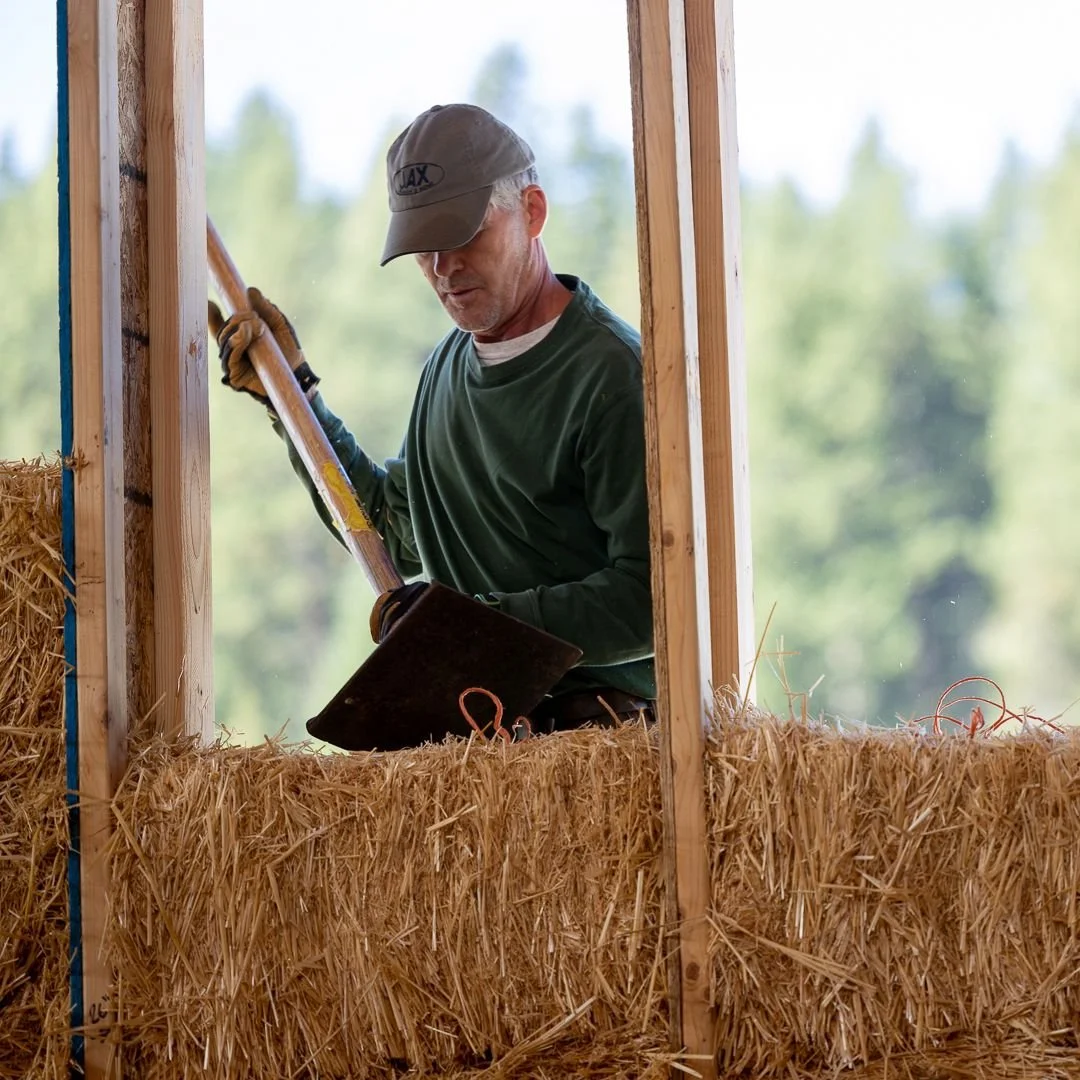
Labor is often the largest portion of the budget.
Straw bale construction includes stacking, shaping, prepping, and plastering. This work takes time and skill, and that time shows up in the final cost.
You have three main paths to consider:
Hire a contractor
Owner-build
Use a hybrid approach
Each path shifts the cost in different ways. Hiring a contractor increases cash cost but improves speed and coordination. Owner-building reduces cash cost but requires a large investment of time and energy.
Workshops and community builds are another path. They reduce labor costs while adding education and support.
Materials Are Only Part of the Story
Straw bales are not expensive. The full wall system includes structure, plaster, windows, doors, and moisture detailing.
Finishes also play a major role. Higher quality finishes cost more upfront but last longer. Lower-cost finishes reduce initial cost but require replacement sooner.
One place to avoid cutting corners is plaster. It protects the wall system. If plaster fails, the cost to repair the damage will exceed any savings.
Location Changes Everything
The same home will cost different amounts depending on where it is built.
Concrete, lumber, and labor all vary by region. Even within the same state, costs shift between rural and urban areas.
The most reliable way to get a starting point is to talk with local builders. Ask for a rough cost per square foot for a home with similar quality and complexity .
You are not looking for precision at this stage. You are looking for a range that helps guide your next step.
Straw Bale vs Conventional Cost
People often ask if straw bale costs more than conventional construction.
The honest answer is that it depends on how you compare.
If you compare based only on square footage, the numbers may look similar or slightly higher due to plaster and labor. If you compare performance, durability, and long-term energy use, the picture changes.
Straw bale homes offer high insulation, reduced energy use, and low-toxicity materials. A fair comparison includes both upfront cost and long-term performance .
How to Know If You Are in the Right Range
You do not need exact numbers early on. You need direction.
Here is a simple process you can follow:
Talk to three local builders
Ask for the cost per square foot for a similar quality home
Adjust for your design complexity
Add a margin for unknowns
This gives you a working range. If the range fits your budget, move forward into design. If not, adjust size, complexity, or approach before investing more time and money.
Where Most People Go Wrong
Most cost problems come from a few common issues:
Starting design without a budget framework
Underestimating labor
Choosing complex forms too early
Skipping detailed planning
These mistakes lead to redesigns, delays, or stalled projects. You avoid them by aligning your design, budget, and expectations from the start.
What This Means for You
If you came here looking for a number, this may feel different from what you expected.
If you came here to understand how to approach your project, you now have a clear path.
You do not need a perfect estimate to begin. You need a realistic range, a clear design direction, and the right people involved early. From there, your numbers become more accurate as your project becomes more defined.
Ready to Take the Next Step?
If you want help aligning your design with your budget:
You do not need to guess your way through this.